
Photon Power 12V System: Compact Behind-Seat Off-Grid Power Deployment
Overlanding Vehicle Owner
A comprehensive 12V electrical infrastructure integrating high-output multi-source charging, centralized DC distribution, and a 3000W inverter into a compact behind-seat layout for utility vehicles.
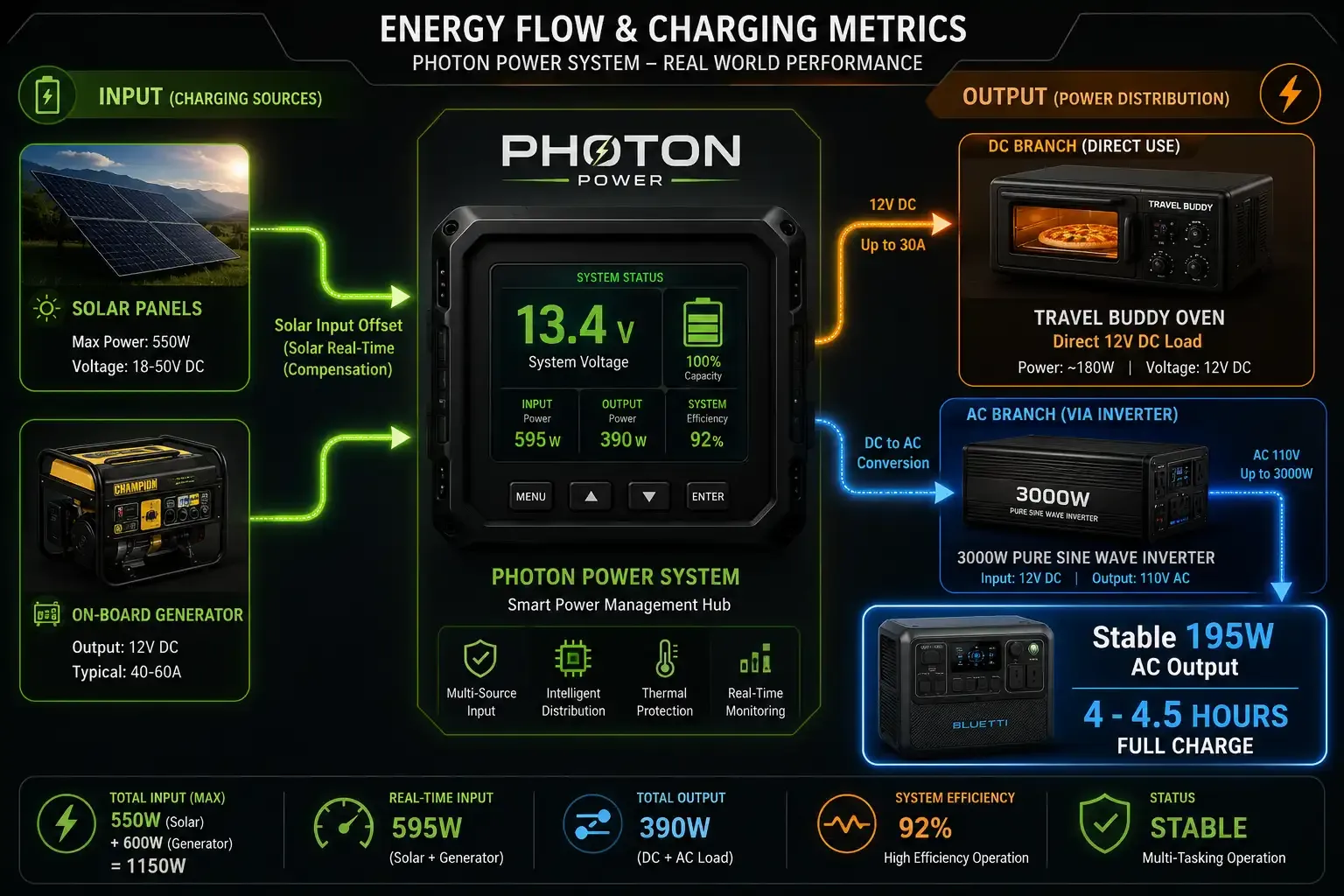
Key Results
3000W
AC Output
195W Constant
Stable Power Delivery
135Ah Deep Cycle
Battery Storage
1. Executive Summary
This case study evaluates the installation and a one-month field performance evaluation of a comprehensive 12V electrical infrastructure developed by PHOTON POWER and retailed by Vicoffroad. Designed for compact footprint integration behind the passenger seats of a standard utility terrain vehicle (Ute), the system provides off-grid autonomy during weekend overlanding and short-term touring expeditions. The system successfully addresses challenges in modern mobile power deployments by integrating high-output multi-source charging (alternator and solar), centralized DC distribution, and substantial heavy-duty AC inverter capacity into a localized, hidden-wire mounting board layout.
2. The Challenge
Overlanding and off-road touring demand robust auxiliary power configurations to sustain food preservation, cooking appliances, and electronic charging infrastructure. Traditionally, these builds face structural and technical limitations:
- Spatial Constraints: Standard dual-battery setups often occupy critical bed volume or require permanent modifications. The client required a low-profile installation fitting entirely within the neglected cabin space behind the rear seats.
- Multi-Source Charging Integration: Efficiently routing power from both the vehicle’s alternator (starter battery) and secondary solar arrays without suffering from line voltage drops or complex manual isolation switches.
- High AC Load Demands: Operating portable lithium power stations and cooking equipment requires a highly capable inverter that safely manages thermal profiles and delivers clean sine-wave electricity.
3. The Solution (System Architecture)
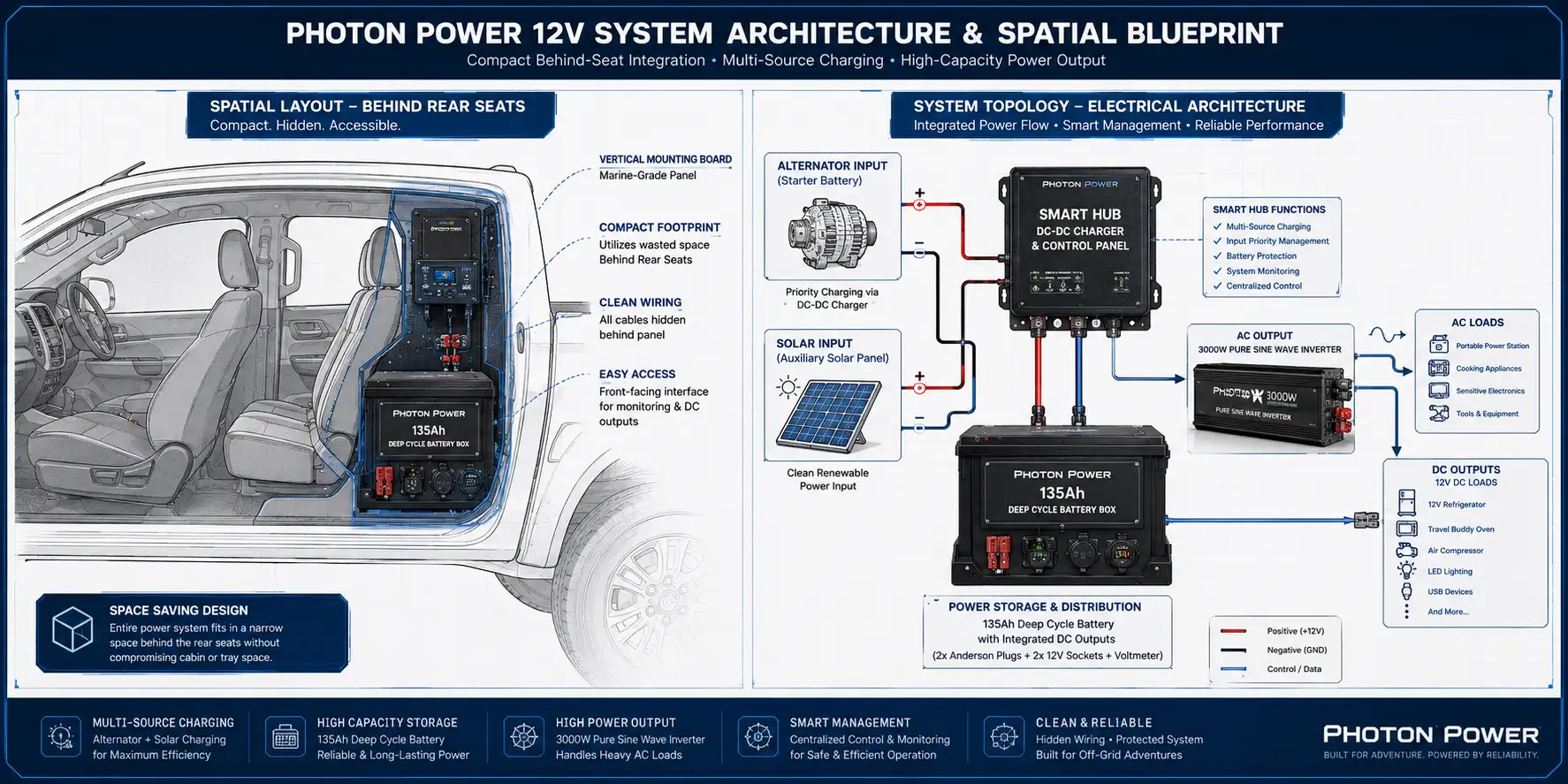
The client implemented an integrated ecosystem manufactured by PHOTON POWER, pre-wired out-of-sight behind a vertical marine-grade mounting board. The layout comprises three main functional pillars:
- A. Power Storage & Direct DC Interface: The core storage consists of a 135Ah Deep Cycle Battery housed within a specialized heavy-duty PHOTON POWER Battery Box. This unit acts as a rugged mechanical armor and a micro-distribution center, presenting two high-current Anderson plugs and two 12V cigarette lighter sockets directly to the user interface panel. An integrated digital voltmeter is aligned outward for immediate state-of-charge tracking.
- B. Advanced Charge Control & Centralized Management: The PHOTON POWER DC-to-DC Charger paired with a Smart Hub Control Panel regulates power routing. This hub serves as an intelligent gatekeeper, integrating a priority input from the vehicle alternator alongside a dedicated solar input. The Smart Hub streamlines all connections into a centralized, single-switch control panel that hides the extensive wire loom behind the mounting board.
- C. High-Capacity AC Power Generation: For heavy AC demands, a PHOTON POWER 12V 3000W Pure Sine Wave Inverter is directly coupled to the auxiliary bank. This allows the system to run sensitive domestic electronics and heavy thermal appliances that typical 500W–1000W vehicle inverters cannot sustain.
4. Field Performance & Operational Outcomes
Following a continuous one-month evaluation period leading into an active weekend tour, the system demonstrated reliable operational metrics under simulated camp conditions:
- Key Performance Metric (Power Bank Replenishment): When a Bluetti Portable Power Station was connected to the 3000W Inverter AC outlet, the system sustained a constant 189W–195W stable power delivery, projecting a complete 0–100% full recharge cycle in approximately 4 to 4.5 hours.
- Strategic Camp Mobility: By utilizing the 3000W inverter to pre-charge a portable power station while driving or in camp, the operator could move a 12V refrigerator directly next to the campfire site, eliminating repetitive trips to the vehicle.
- Simultaneous Multi-Load Handling: The system managed a continuous high-current draw for a 12V Travel Buddy marine oven directly from the auxiliary bank, while concurrently handling AC inverter inversion and balancing input from an auxiliary solar panel array delivering real-time offset into the Smart Hub.
5. Future Expansion Roadmap
To further scale the system’s operational flexibility, the engineering path includes:
- External Canopy Integration: Routing heavy-gauge Anderson lines through the cabin wall via weatherized bulkheads into an external aluminum tray toolbox.
- Dedicated Remote Utility Hub: Transitioning the 12V refrigerator and a fixed-mount air compressor into the external toolbox enclosure for optimized airflow and noise suppression inside the passenger cabin.