
Optimizing Off-Grid Portable Power Deployment
RV Owner & Boondocking Enthusiast
A field performance analysis of the Photon Power 120W Folding Monocrystalline Solar Panel Blanket, evaluating its capacity to extend battery cycle life and mitigate grid dependency.

Key Results
Up to 21%
Conversion Efficiency
+24 to +48 Hours
Autonomy Extension
120W
Max Power Output
1. Executive Summary
This case study evaluates the real-world operational performance, hardware integration, and field deployment limitations of the Photon Power 120W Folding Monocrystalline Solar Panel Blanket, supplied by Vic Offroad. Evaluated under standard recreational off-grid vehicle (RV) environments, the study analyzes its capacity to extend battery cycle life, mitigate grid dependency during boondocking, and cross-examine user-experience friction points against factory laboratory configurations.
- Cell Conversion Efficiency: Up to 21%
- Off-Grid Battery Autonomy Extended: +24 to +48 Hours
- Core Technology: A-Grade Monocrystalline with MPPT Tracking
2. The Challenge: Sustainable Trickle Charging for Mobile Microgrids
Mobile off-grid applications require consistent energy replenishment to combat auxiliary parasitic draws and base load demands (such as DC refrigeration, lighting, and water pumps). Standard heavy-gauge rigid panels lack the spatial flexibility required for variable campsite footprints, while traditional PWM controllers underperform in dynamic weather situations.
The core challenge lies in engineering an ultra-portable, high-efficiency solar harvesting system capable of extending deep-cycle or lithium battery runtime without adding excessive volumetric or structural weight to the vehicle fleet.
3. Hardware Architecture & Technical Specifications
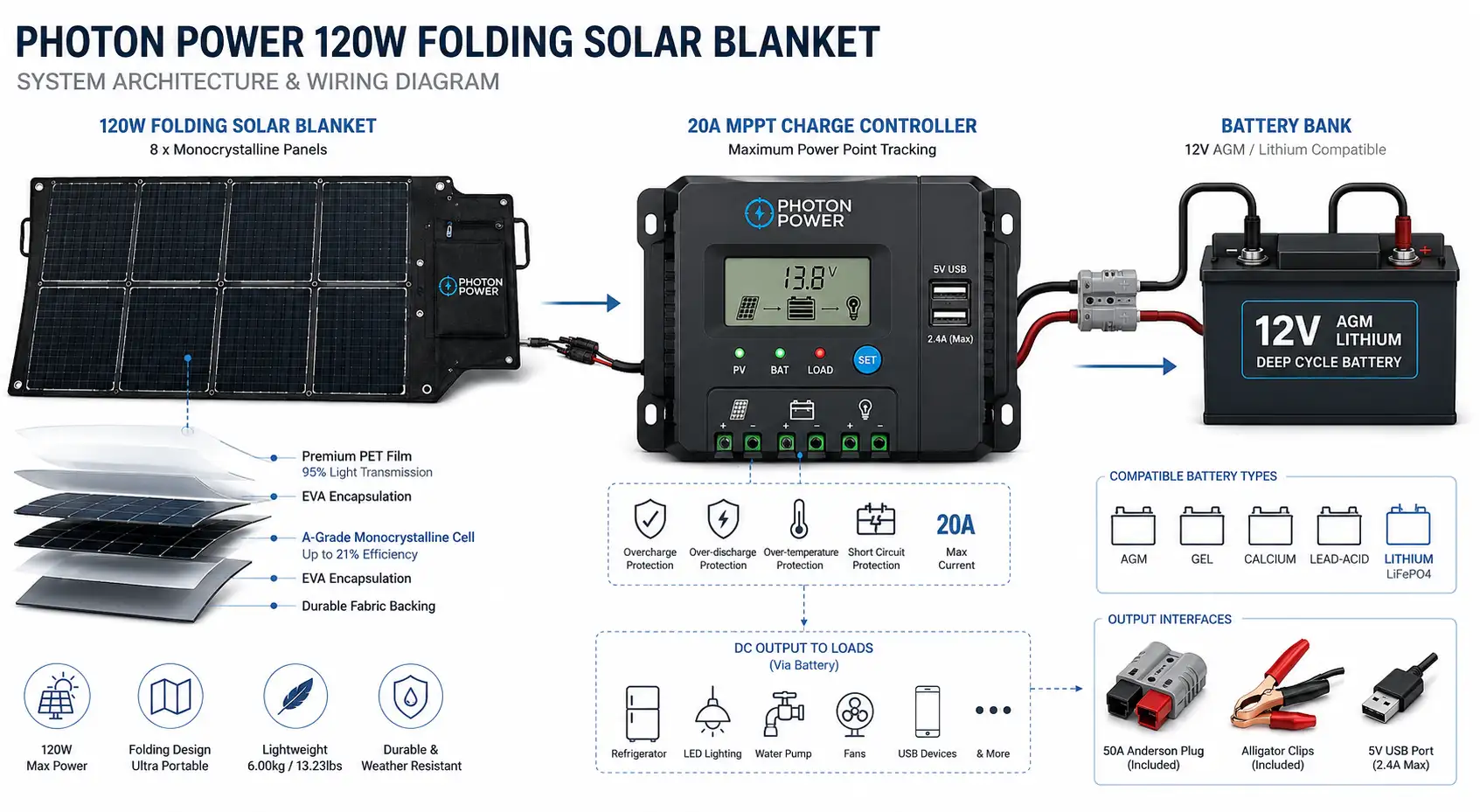
The Photon Power system shifts away from rigid glass encapsulation, utilizing a flexible multi-segment design built with A-grade monocrystalline cells embedded under premium PET protective films. This material composition achieves up to 95% light penetration, allowing for optimized photon capture.
- Maximum Power Output: 120W
- Folded Dimensions: 18.31″ L x 14.76″ W x 4.33″ H
- Unfolded Dimensions: 50.39″ L x 29.13″ W x 0.24″ H
- Gross Net Weight: 13.23 lbs (6.00 kg)
- Controller Topology: Maximum Power Point Tracking (MPPT) – 20 Amp Rated
- Battery Chemistry Profiles: Lead-Acid, Gel, Calcium, AGM, and Lithium-Ion
- Output Interface: 50A Anderson Plugs, Alligator Clips, and a 5V USB Port
4. Performance Validation & Field Testing
Field diagnostic routines were executed across varying solar irradiance thresholds to validate the manufacturer’s performance models against actual campground variables.
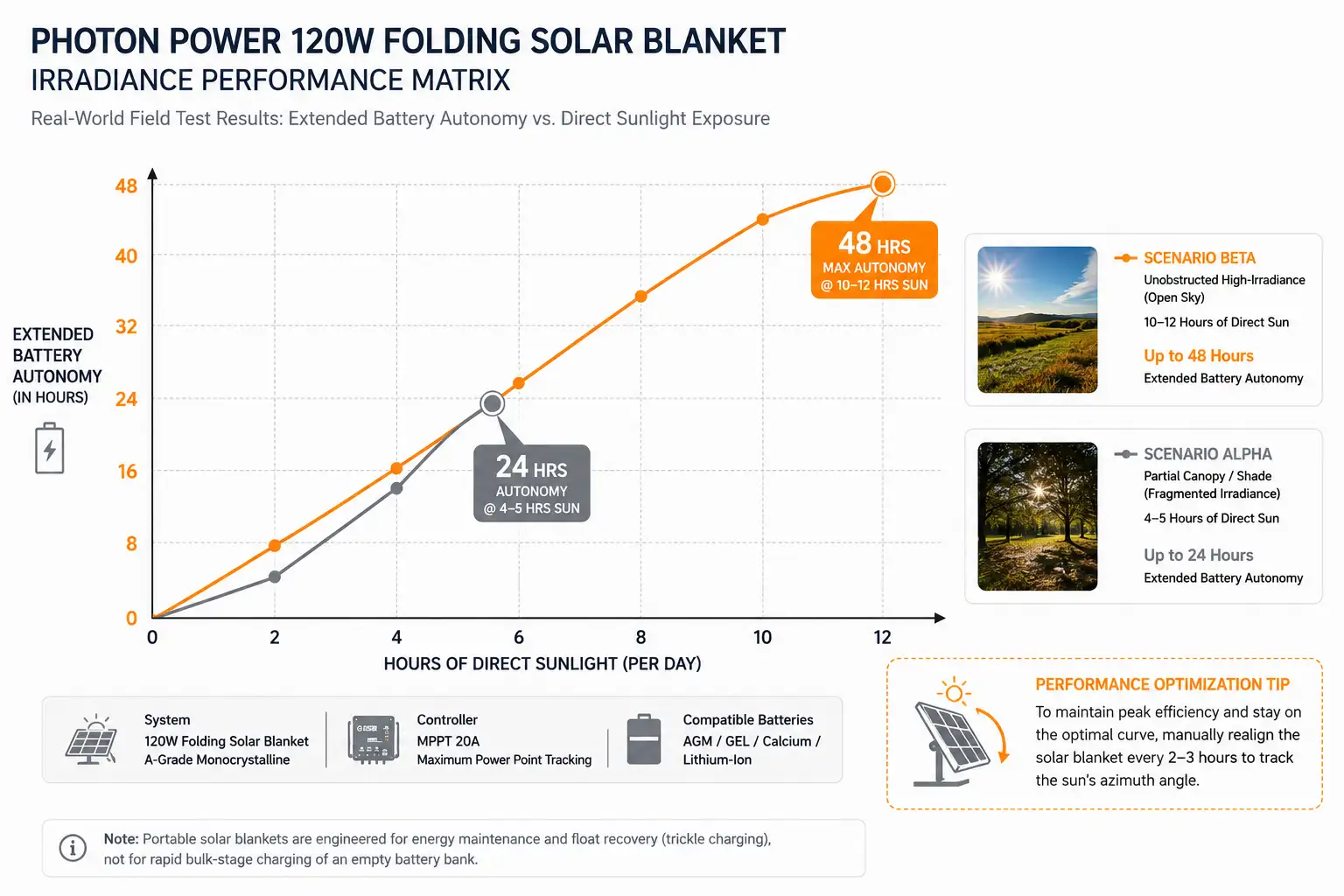
Critical Operational Rule: Portable solar blankets are mathematically engineered for energy maintenance and float recovery (trickle charging), rather than rapid bulk-stage restoration of an empty battery bank. Bulk recharging must be deferred to higher-voltage AC shore power or inline generators.
Scenario Alpha: Partial Canopy & Fragmented Irradiance
- Environment: Moderate tree canopy coverage, yielding localized shade and diffused light.
- Exposure Window: 4 to 5 hours of direct afternoon sun exposure.
- Empirical Result: Successfully extended the vehicle’s battery life cycle by approximately 24 hours past baseline expectations under continuous base load.
Scenario Beta: Unobstructed High-Irradiance Cleared Environment
- Environment: Zero tree canopy interference, ideal open plain sky.
- Exposure Window: 10 to 12 hours of continuous solar irradiance.
- Empirical Result: Maximized system output, extending battery autonomy by 48 hours beyond normal non-solar runtimes.
Mathematical Efficiency Optimization Note: To maintain peak efficiency where current (I) is maximized, the solar matrix requires manual realignment relative to the sun’s azimuth angle every 2 to 3 hours. Failure to track this angle results in a notable decrease in real-world energy output.
5. UX Diagnostics: Key Advantages & Structural Limitations
Engineering Advantages
- Volumetric Efficiency: The 8-panel segmented configuration collapses down to a fraction of its operational area, enabling quick storage in vehicle pass-through compartments.
- Enclosure Durability: The inward-folding protective method protects the sensitive PET-coated monocrystalline cells from external friction or scratching during transit.
- Plug-and-Play Integration: Standardized 50-Amp Anderson connectors coupled with color-coded alligator clips simplify installation and prevent polarity faults.
Mechanical Vulnerabilities & Product Gaps
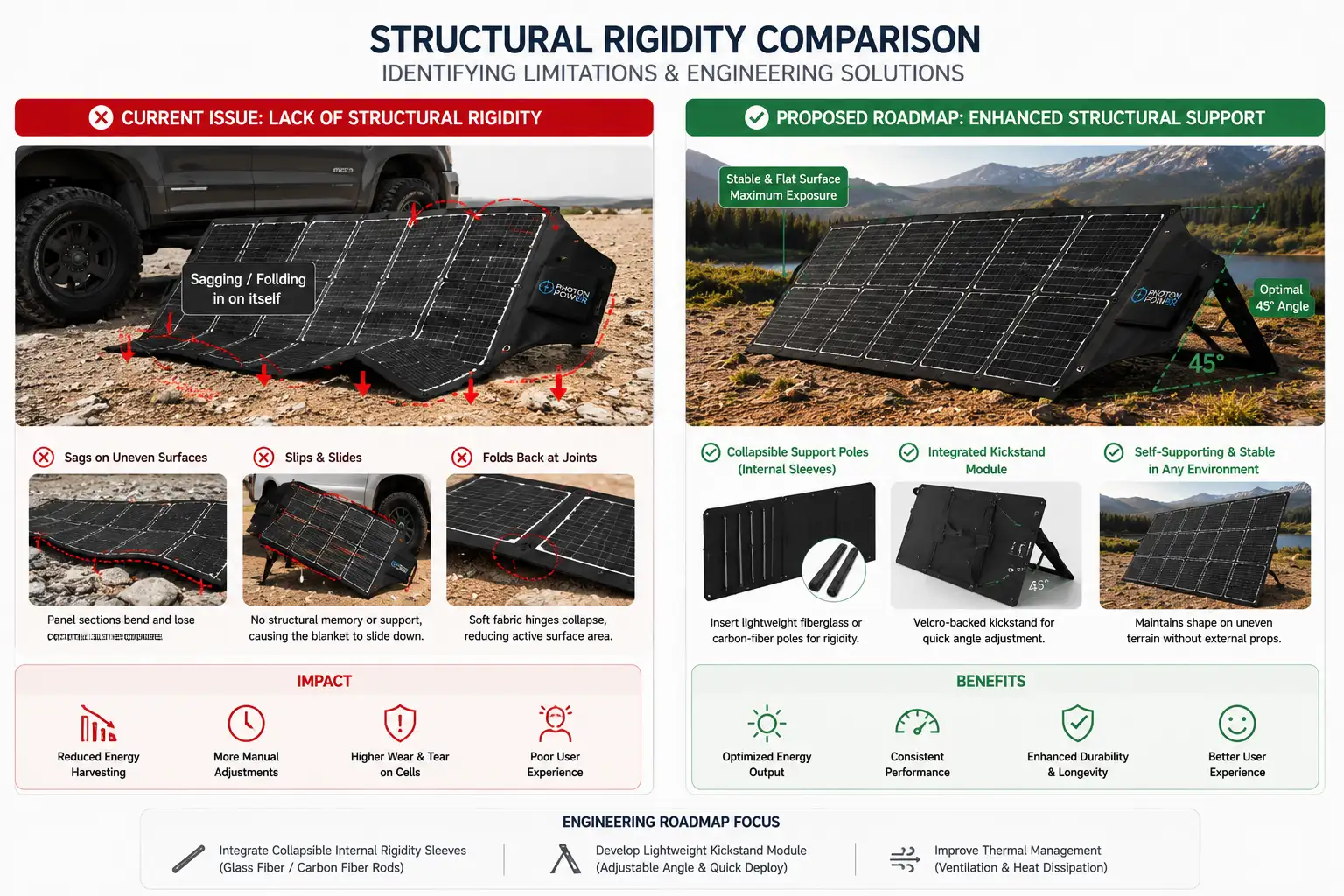
The primary mechanical limitation observed involves a deficiency in structural rigidity. Because the unit is structured as a flexible fabric blanket comprising 8 to 10 small panels arranged in a dual-strip array, it lacks structural memory and tends to fold back on itself or sag when placed on irregular surfaces.
The lack of an integrated structural kickstand or internal rigid channels restricts optimal angular positioning. Users are forced to lean the blanket against existing vehicles or manually craft ground-tether lines via the integrated stitched loops.
6. B2B Strategic Recommendations & Product Engineering Roadmap
- Integrate Collapsible Internal Rigidity Sleeves: Introduce lightweight, segmented fiberglass or carbon-fiber structural rods that can slide vertically into pre-stitched sleeves to stabilize the layout.
- Develop a Lightweight Kickstand Module: Update the product package with an integrated, velcro-backed variable angle kickstand frame to allow rapid orientation adjustments without external support structures.
- Thermal Management Enhancements for Fixed Application: Given user field feedback regarding thermal degradation in prolonged marine or high-UV setups, future iterations should explore back-plate ventilation channels to prevent cell bubbling and thermal-induced output drops.
7. Conclusion
The Vic Offroad Photon Power 120W Folding Solar Panel Blanket proves to be an exceptionally competent option for short-to-medium-term boondocking applications, providing measurable runtime extensions (+24h to +48h) through its premium monocrystalline build and robust MPPT optimization. By addressing structural rigidity limitations via targeted hardware improvements, it represents a highly scalable and reliable modular energy asset for modern portable networks.